
Automate the work around the line, and on it.
For plant managers, operations and quality leaders, maintenance and reliability teams, planners and the office teams that feed production. Our engineers work on your floor and in your offices and automate the work with agentic workflows, custom models and knowledge built on your orders, specifications, work orders, quality records, sensor data and images.

Texas is building. Someone has to keep it running.
Texas is where we start. The state is putting public money behind new manufacturing, and every new line needs maintenance people who know it.
$1.4 billion
for semiconductor manufacturing and development under the 2023 Texas CHIPS Act, which created the $698.3 million Texas Semiconductor Innovation Fund.1
About 51,900 openings each year
for industrial machinery mechanics, machinery maintenance workers and millwrights in the U.S. from 2025 to 2035. Employment is projected to grow 14 percent, much faster than the average for all occupations.2
82.5%
of Texas manufacturers that use AI have only piloted it or use it with a small share of their employees, according to the Dallas Fed's May 2026 survey. Only 15% say many of their employees use it regularly.3
New plants bring new equipment, new procedures and teams with less time on the machines. We build software that gives newer technicians the knowledge of your most experienced ones, at the machine, with the source.
1 Manufacturing Dive, "Texas ready to invest $1.4B in state chip industry", published June 14, 2023, accessed October 13, 2026.
2 U.S. Bureau of Labor Statistics, Occupational Outlook Handbook, Industrial Machinery Mechanics, Machinery Maintenance Workers, and Millwrights, projections 2025 to 2035, accessed October 13, 2026.
3 Federal Reserve Bank of Dallas, Texas Manufacturing Outlook Survey, special questions, collected May 12 to 20, 2026, accessed October 20, 2026.
Where plants lose time
The work order says "service filler".
The technician hunts for the manual, the parts and the lockout points, and half the window is gone before a wrench turns.
The stop nobody wrote down.
Night shift fixes a recurring stop and moves on. Day shift hits the same stop and starts from zero.
The defect found three stations too late.
A missing torque mark or a miswired terminal is caught at final test, and rework costs a day per unit.
The 2 a.m. tool-down.
The night technician has the alarm code and a 900-page manual. The engineer who has seen it before is asleep.
The expert who retires next year.
What your best people know about these machines and these parts is not in any procedure.
The order that arrives as a PDF.
Customer service retypes every order and request for quote into the ERP, checks revisions by hand, and the quote goes out days later.
What we build for plants
Agent marks work an AI agent runs. Model marks work a trained model does. How our models work
Agentic workflows Agent
Agents read incoming orders and requests for quote, check them against your item master and draft the quote. Others open nonconformance reports and draft the corrective action from the inspection record and past cases. A planning agent turns each preventive or corrective work order into a complete job package. It holds procedure steps from the OEM manual, lockout and tagout points, sanitation requirements, parts and kits with stock status, and the last three jobs on that asset. A scheduling agent fits the packages into changeover and sanitation windows. The planner approves every package.
Custom models Model
Vision models at the assembly station that check the build against the order before the unit moves. Diagnostic models trained on alarm and event logs that rank the likely cause of a stop and link the procedure. Telemetry models that flag the sensor drift that came before past failures.
Custom applications
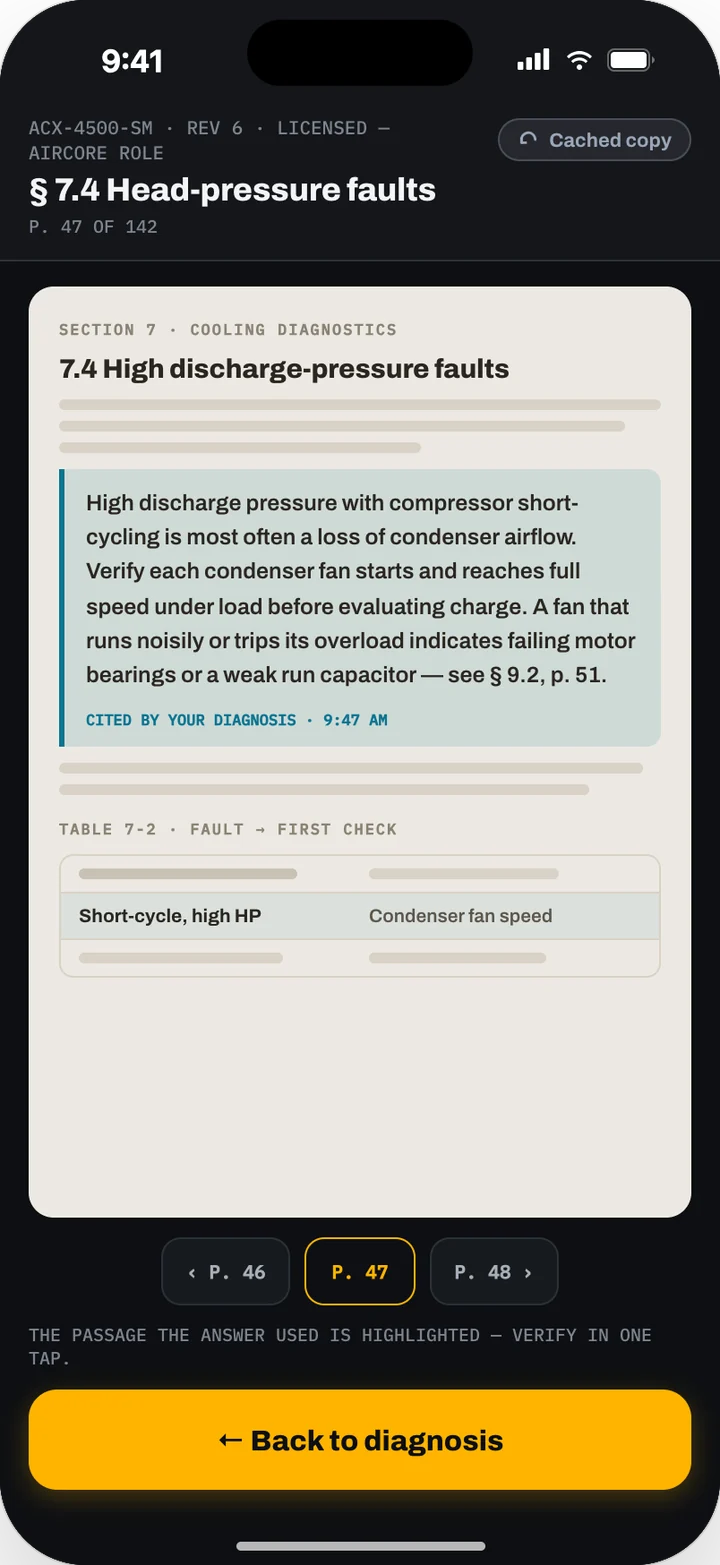
Applications your people use every day. One example is a mobile app for technicians and line leads. They log a stop by voice, photo and fault code, find what worked last time on that station, and hand over the shift from the logged events.
Knowledge: the Company Brain
Your specifications, drawings, work instructions, machine manuals, nonconformance history, setup sheets and the recorded know-how of your senior people, in one knowledge layer that answers at the machine with its source.
Example engagements in manufacturing
Each starts with a six-week First Build, or longer for sites that need a security review first. The measures are targets agreed with you during scoping and tracked against your own baseline.
Maintenance job packages
Food and beverage plants: bottling, dairy, snacks, meat processing. Build: 8 to 10 weeks.
What we measure: PM schedule compliance, wrench time as a share of the shift, jobs delayed for missing parts or information, planner hours on package assembly.
Assembly verification by camera
Energy equipment plants: switchgear, transformers, generator sets, power distribution units. Build: 10 to 14 weeks.
What we measure: defects found at final test per 100 units, rework hours per unit, false-reject rate at the station, inspection seconds per unit.
Tool-down diagnosis
Semiconductor fabs, and the field service teams of fab equipment suppliers. Build: 12 to 16 weeks, after longer scoping for security review.
What we measure: mean time to repair on the target tool set, unscheduled downtime hours, repeat alarms within 7 days, night-shift events closed without engineer escalation.
Line-side troubleshooting and shift handover
Automotive and EV plants and their Tier 1 and Tier 2 suppliers. Build: 8 to 12 weeks.
What we measure: unplanned downtime minutes per shift on the target line, repeat stops with the same cause within 14 days, handover completion rate, time from stop to restart on recurring faults.
Retiring-expert capture
Aerospace and defense suppliers: machining, composites, special processes. Build: 8 to 12 weeks.
What we measure: critical tasks with a reviewed procedure, weeks for a new hire to reach independent sign-off, questions to the experts per week, repeat nonconformances on the target part families.
What it runs on
Company Brain
The knowledge layer under every plant engagement: manuals, procedures, history and expert know-how, with the source on every answer and access limited to the people cleared to see it.
How the Company Brain worksZylergy Field mobile app
The mobile app built for service technicians, adapted for the plant floor: identify the machine, open its history, follow cited steps and log what was done.
See line-side troubleshootingZylergy Facilities
Asset records, preventive maintenance and compliance scheduling for the equipment and inspections the plant must prove.
See maintenance job packagesBuilt for plants that cannot send data out
Fabs, defense suppliers and plants with export-controlled work have rules about where data goes, and we work to them. We deploy inside your network or in your own cloud account, limit access to authorized people, and build the security review into Scope before any data moves. Your process knowledge stays yours.
Bring us the stop that keeps coming back.
Tell us about the line, the shift or the machine that costs you the most. An engineer will reply and set up a scoping call, on site if you prefer.