
Built on what your company knows. Answers with their source.
The Zylergy platform turns manuals, service records, technician notes and photos into answers, models and workflows built to hold up in the field. It sits under every product and every engagement we build.
Company Brain
Everything your company knows about its equipment, in one governed place.
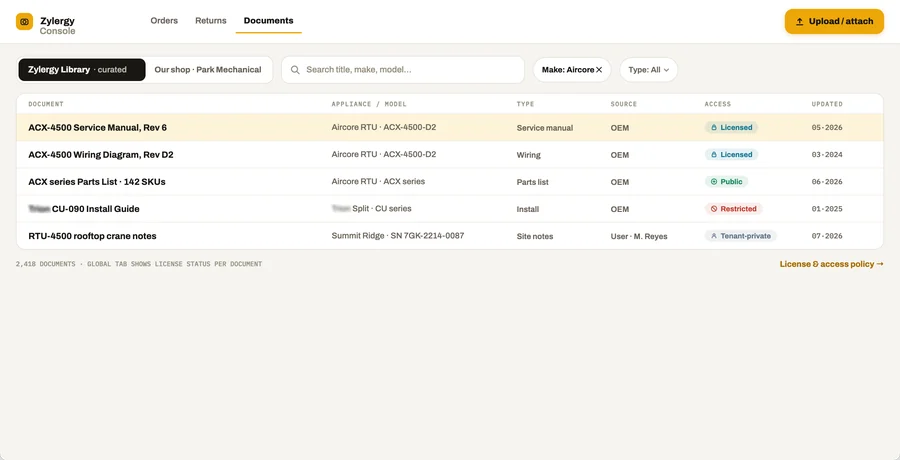
Your knowledge is spread across manuals and service bulletins, wiring diagrams and parts catalogs, closed work orders, technician notes, inspection reports and thousands of photos on phones. The Company Brain brings it together into one knowledge layer and keeps it in order.
What goes in
- Manufacturer manuals, service bulletins, wiring diagrams and parts catalogs, from PDF or scan
- Work order and ticket history, including how each job was closed
- Technician notes, readings and checklists
- Photos of parts, nameplates and finished work
- Your own procedures, price books and standards
How it is kept in order
- Every document is linked to the makes, models and serial ranges it applies to.
- A person verifies each document and decides who may see it: internal staff, a dealer tier, a contractor, or nobody outside the company.
- Manufacturer content reaches only the people entitled to it.
- Every change is logged.
What comes out
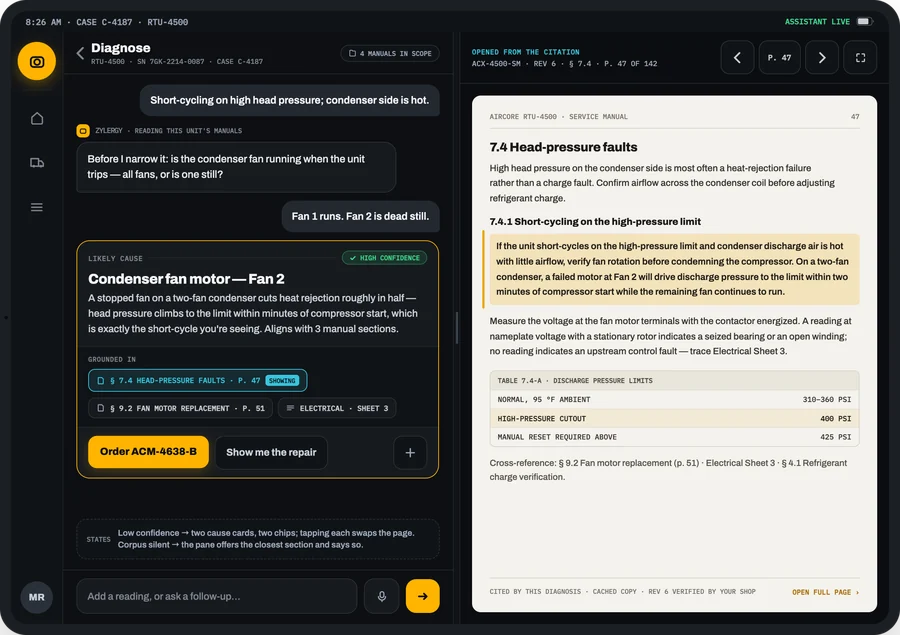
An answer to a question, in the field, with the document and page or the work order it came from. When there is no source, it says so, and the question goes to a person whose answer is added. The open questions become a list of what your documentation is missing.
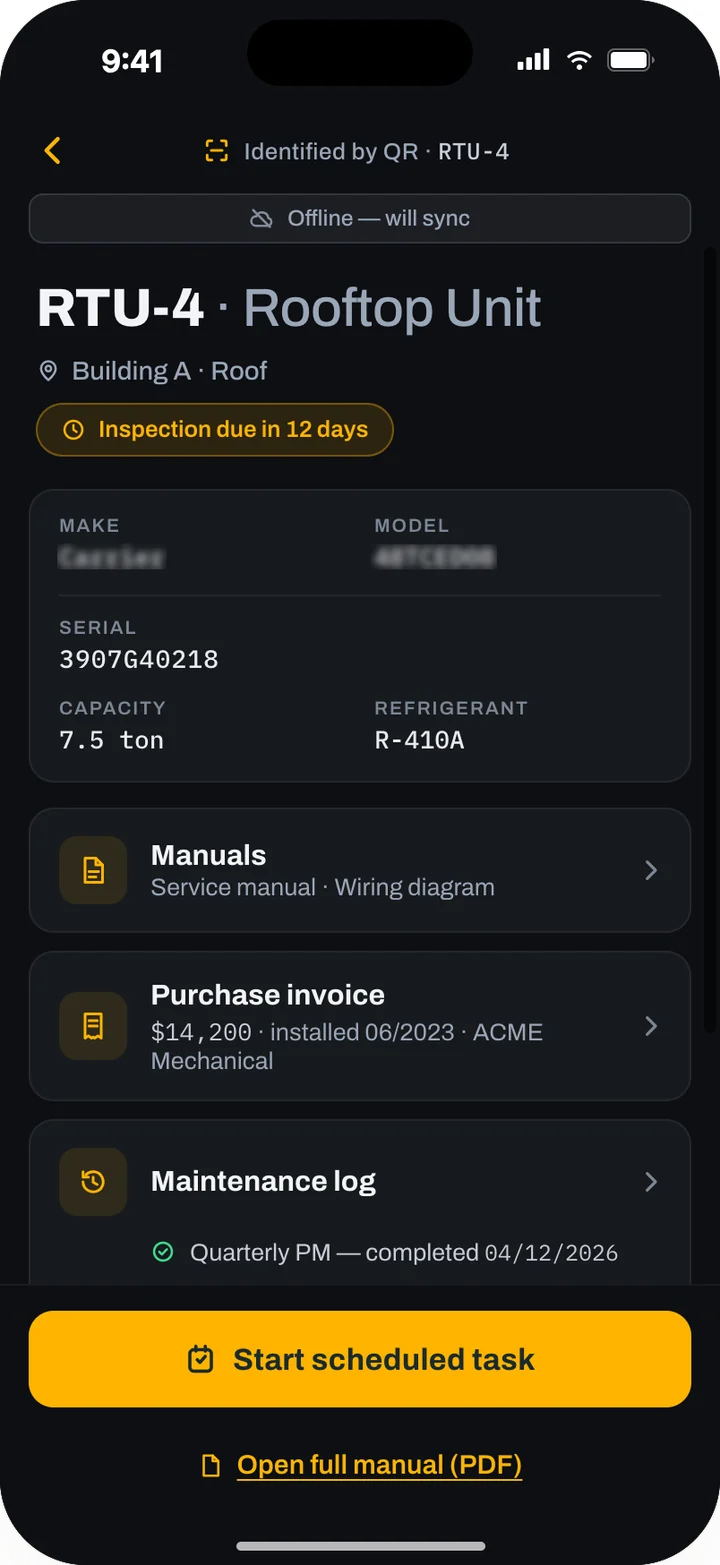
On a single asset, the Company Brain becomes that asset's record: specifications, manuals, purchase invoice, maintenance log and compliance status, one scan away.
Specialty models
General-purpose AI is trained mostly on public data. Field work needs models trained on real parts and nameplates, including photos taken in bad light. These are the models our products and engagements are built on.
Vision on parts
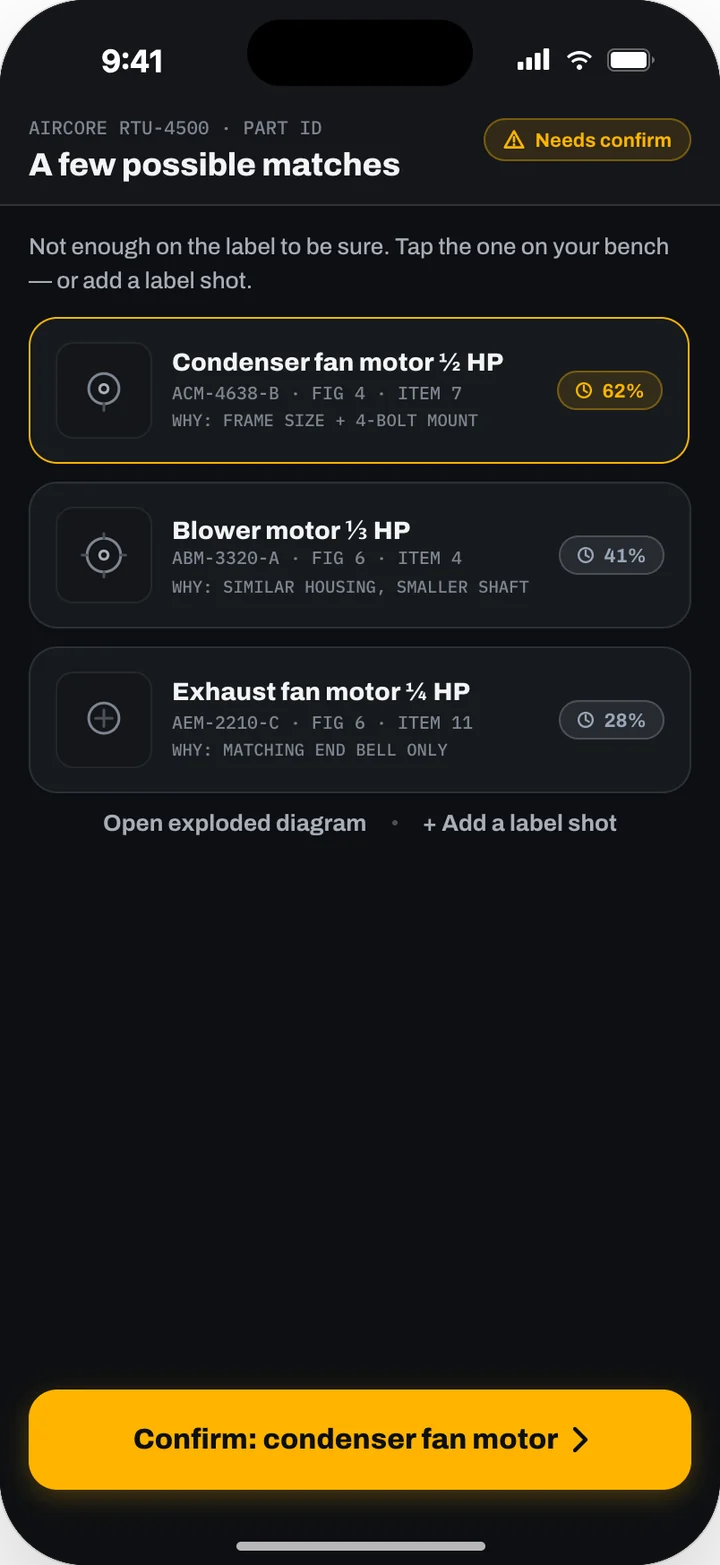
Identifies a part from a photo by matching it against the catalog for that exact unit: a few hundred candidate parts, not the millions in a distributor catalog. When it is not certain, it returns a ranked short list with the reason. On the phone, it runs on the device.
Nameplate and label reading
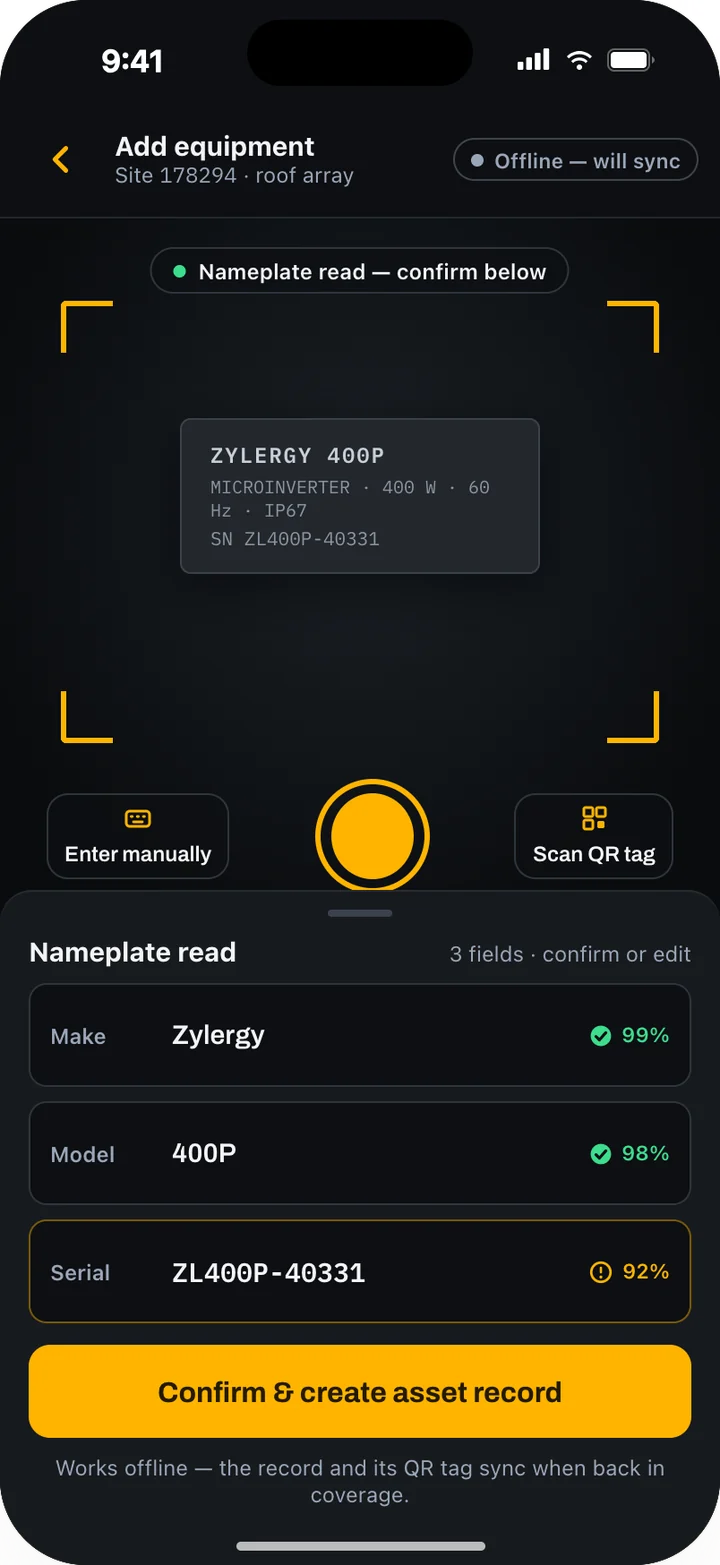
Reads make, model and serial from a nameplate or data plate photo, with a confidence check on every field. It works with no signal. A low-confidence read is flagged, and a person confirms before the record opens.
Document intelligence
Reads manuals, scans and forms, and pulls out what the work needs: maintenance intervals, procedures, acceptance ranges, part lists and code references. A person reviews the result before it is published, and every item keeps its page reference.
Grounded diagnosis
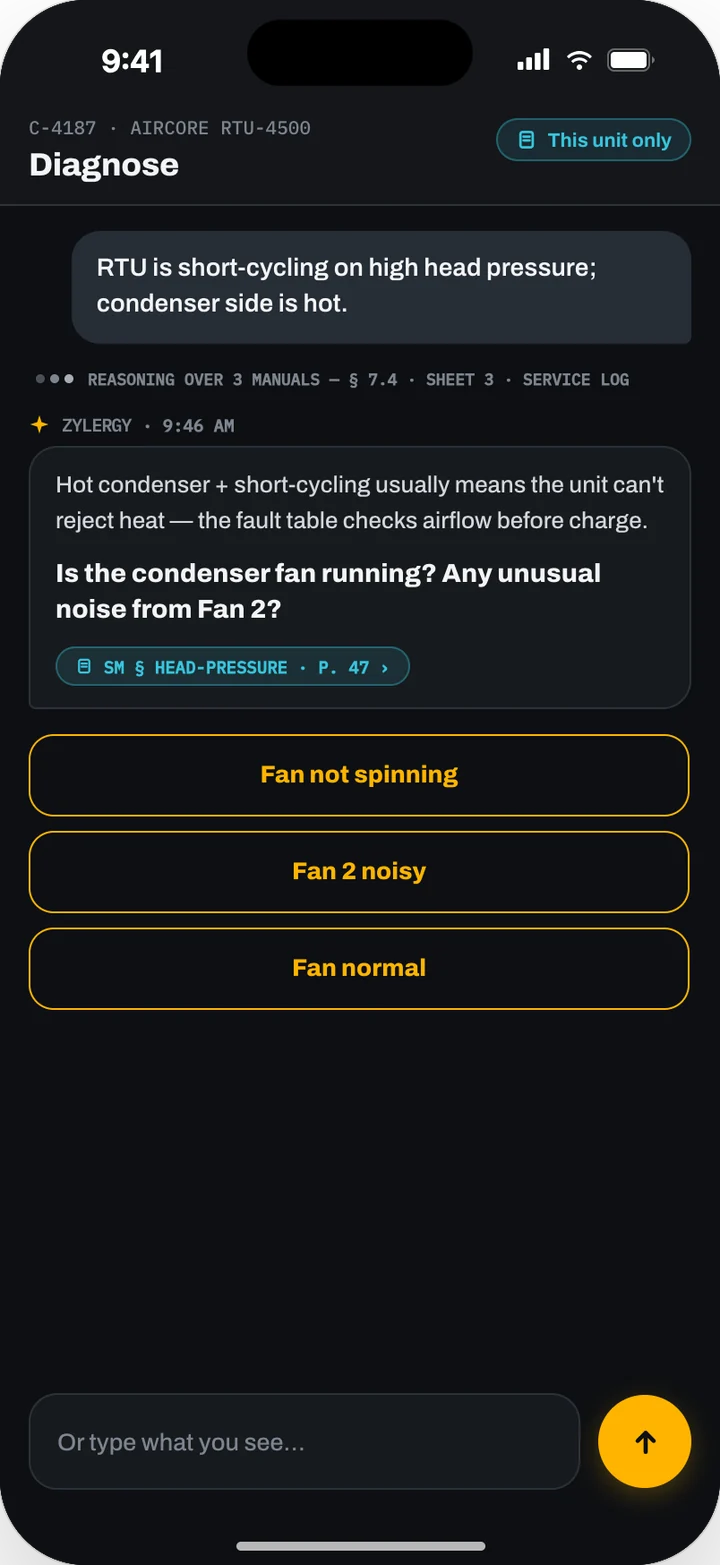
Works a fault the way a senior technician does. It asks one or two questions that separate the likely causes, then ranks them, drawing only on that unit's manuals and service history, each with its citation.
Telemetry fault detection
Reads inverter and battery telemetry and equipment logs, and tells a real fault from noise: a failure, a failure on its way, a slow loss of output, a device that stopped reporting. Each finding comes with the component, the severity and the window to act.
Models built for your operation
Trained on your own images, logs and history when the job calls for it: assembly verification at a station, root-cause ranking from controller fault logs, diagnosis for a specific fleet of equipment. Each is tested on a held-out set of your real cases before it reaches the field, then monitored and retrained when it drifts. Manufacturing
Agents and workflows
Agents that do the job, with a person at the decisions.
Our agents chain the steps that an office or a plant does by hand today, and stop for a person wherever money, safety or a customer commitment is involved. See example engagements
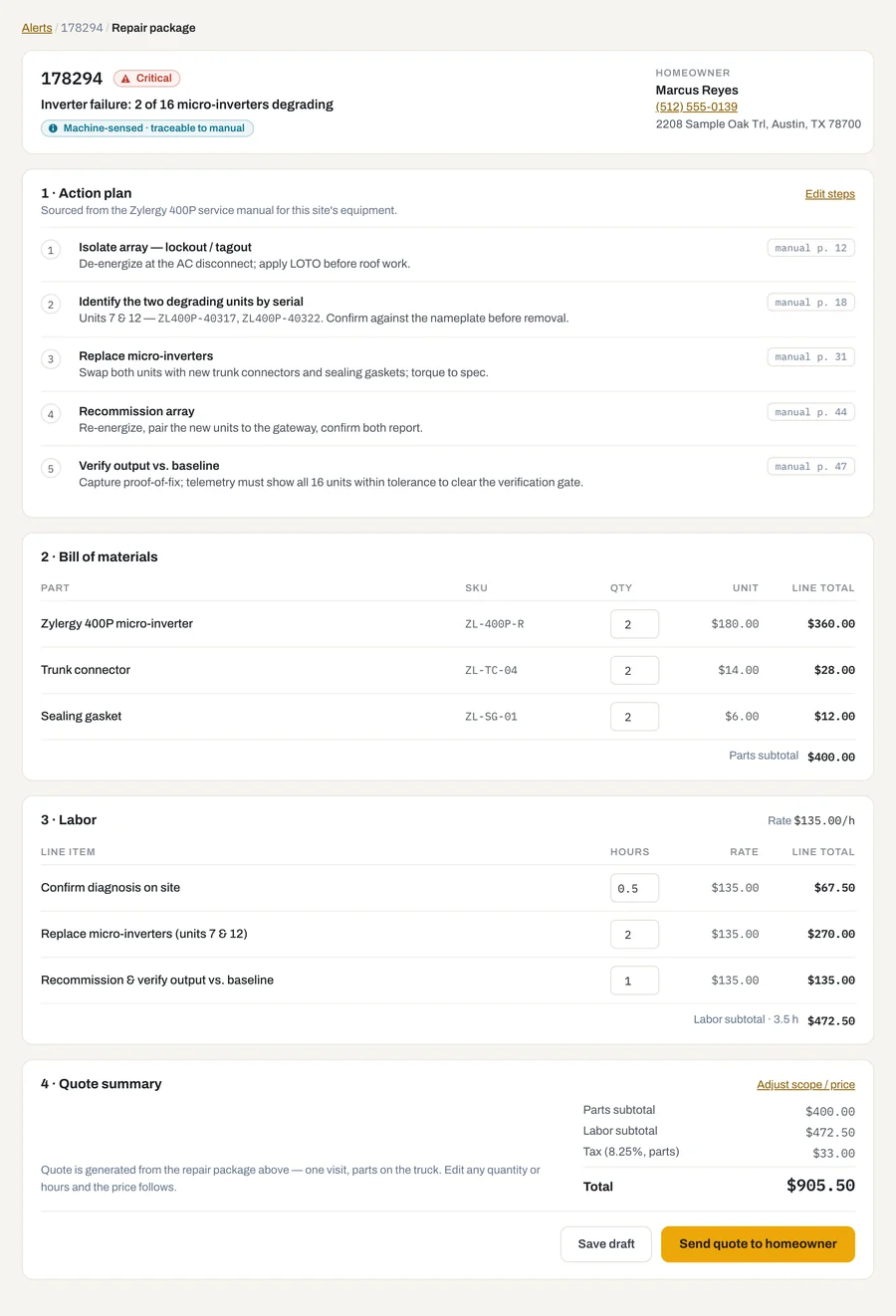
An alert becomes a quoted job.
Alert
An inverter reports a fault.
Triage
One agent separates the real fault from the noise.
Package
Another builds the repair package: the action plan from the manual, the bill of materials, the labor and the price.
Quote
The office reviews the quote, edits a line if needed, and calls the homeowner with a fixed price before anyone drives out.
A call becomes a dispatched visit.
An agent takes the call and asks for the model, serial and symptom. Another proposes the likely causes and checks the parts on the van. The dispatcher approves the technician.
An inspection becomes a priced quote.
Each deficiency becomes a line item with its code reference and a price from your price book. The quote goes out once a person signs off.
Every step shows its reasons and its sources. Results are written back to your system of record.
Grounded answers
Every answer shows its work.
Citation
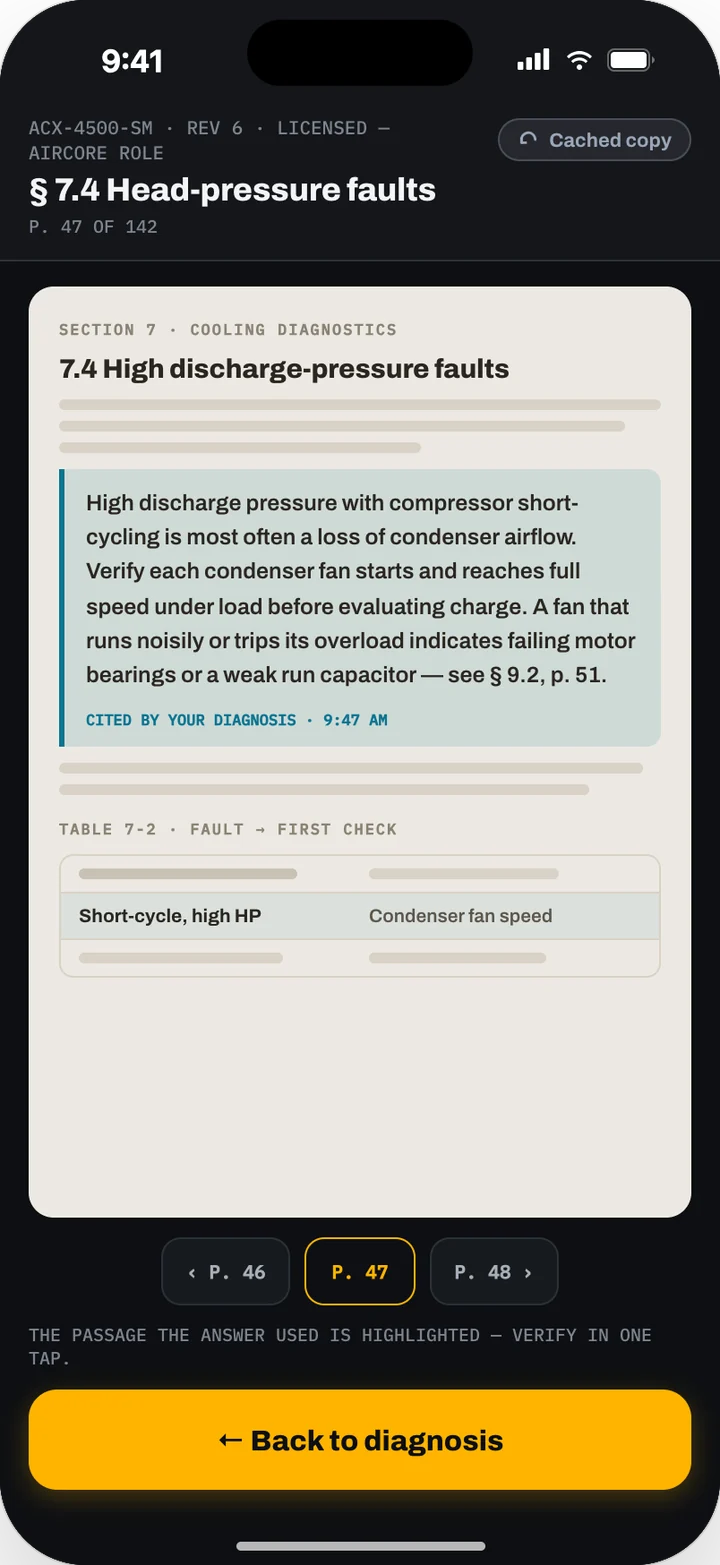
Every answer names the document and page it came from. One tap opens the manual at that page with the passage highlighted.
Confidence
Each likely cause shows how confident the system is and how many sections of the manual support it. The other possibilities stay on screen, ranked.
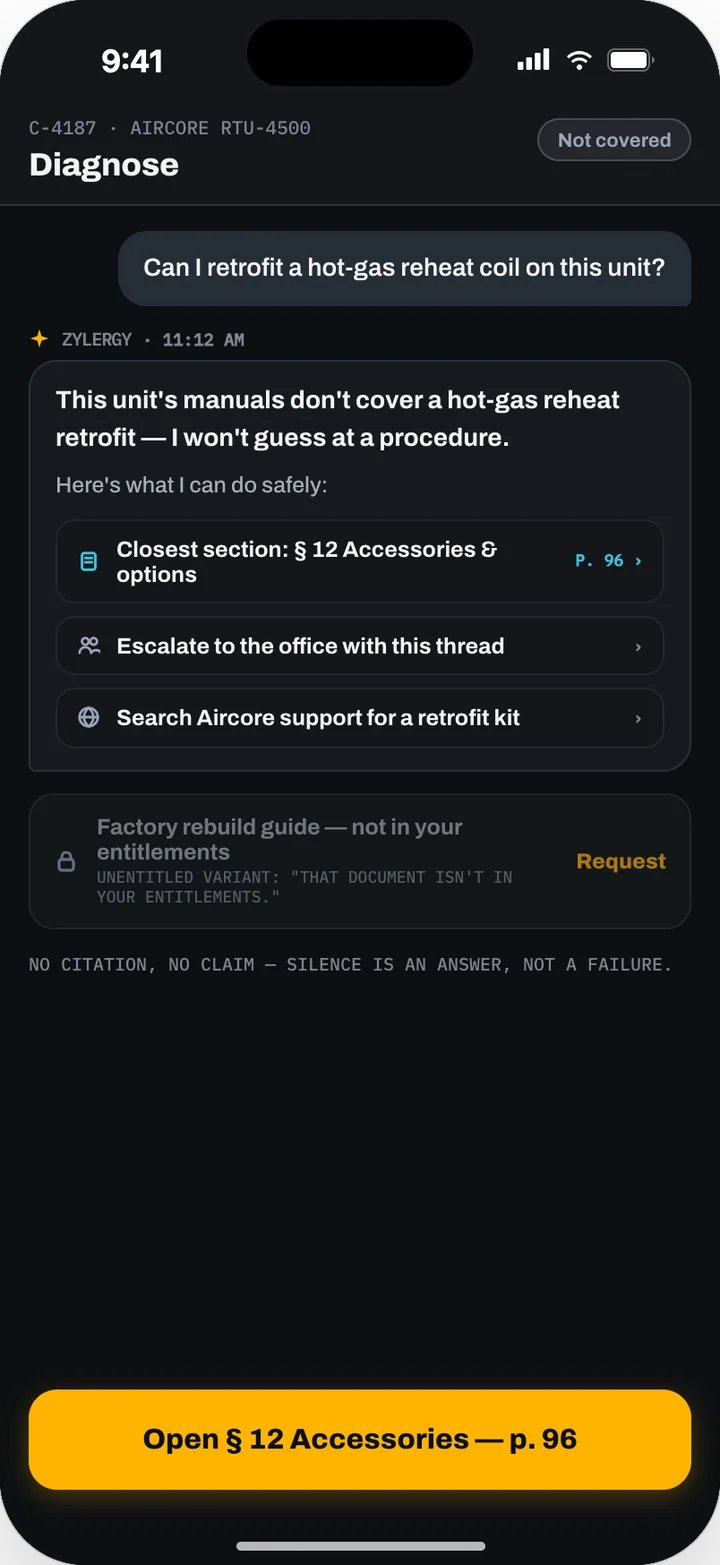
Honest when silent
When your documents do not cover the question, it says so. It offers the closest section or a person to ask, and it does not make up an answer.
Human approval
Quotes, parts orders, contractor routing, dispatch and warranty decisions wait for a person. In Zylergy Solar and Zylergy Facilities, a job cannot close until proof is captured: photos and readings checked against the manufacturer's range.
The know-how of thousands of manual pages, in every technician's hand
Your most senior technician has seen the fault before. They know which page of which manual, which part fails on that model, and what the last technician wrote down. That knowledge is the difference between one trip and two.
We put the same knowledge in every technician's hand. A newer technician on an unfamiliar unit gets the unit's history, the right manual page, the likely cause, the right part and a checklist with the acceptance range for every reading.
Zylergy's software is built so junior technicians can work like the most senior person on your team, and your senior people spend less time on the phone.
Unit identification, cached manuals, part matching and checklists work with no signal. Anything that needs a connection says so.
How we run the models
Tested before release
Every AI feature is checked against a set of known cases before it ships, including whether it cites correctly and declines when it should.
Switched off on its own
Every AI feature can be turned off individually. The product falls back to the manual path, and the work goes on.
One gateway for every model
Models sit behind a single gateway, so we can change a model without changing your workflow.
Support access is scoped and logged
When our staff look at your account to help you, they do so only with your administrator's consent, read-only with export turned off, and every access is logged.
Deployment and data
Where your data lives, who owns what, how our models are trained and how support access works are set out in one place, on our trust page.
See it on your own data.
Bring a manual, a month of work orders or a folder of part photos. An engineer will show you what the platform makes of them.